
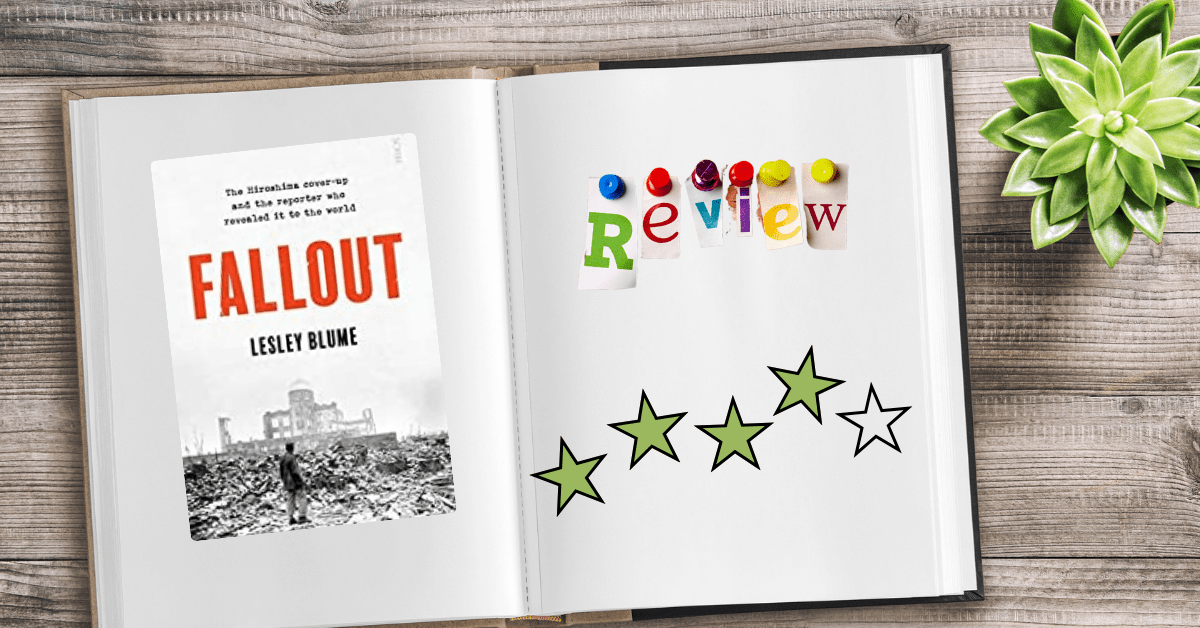
On the Spine of Things:
Prior to reading this book I had no idea there even was a coverup. Or attempted coverup as the case may be. In fact, my knowledge of Hiroshima and Nagasaki was pretty much limited to the horrifying effects of bombs.
After perusing the cover (a devastating photograph of a lone man standing in a pile of rubble that used to be a bustling city) and reading the book description, I had high hopes that I would learn a lot from this book. I was not disappointed.
Beyond the Binding:
Fallout tells the story of Pulitzer Prize winner John Hersey’s quest to bring the effects of Atomic bombs on Hiroshima and Nagasaki, to the attention of the American public, despite systematic efforts by MacArthur’s military and the Truman government to conceal the true impact of the bombs on the Japanese people.
I was never a very good student in high school, and I was unaware that there had even been a coverup until I read this book. Not that I’m surprised. Governments thrive on secrets, and they had just come out of a lengthy and costly war.
The book is written chronologically and is easy to follow, with a photo insert allowing us to put faces to the names Blume writes about. At no point did I feel lost or confused about the timeline. The author is articulate and engaging, and had me experiencing a range of emotions, from horror, to terror, to disgust, to despair, to pity, to melancholy, to sheer rage. Readers should be aware that Blume doesn’t shy away from providing detailed descriptions of the effects and aftermath of atomic bombs, and some of the actions and remarks relayed may be distressing.
The subject matter was new to me beyond the basic general knowledge. I am left with impression that we all owe a debt of gratitude to John Hersey, William Shawn, and Harold Ross, for exposing the peril of these bombs to the public, and the safety such knowledge has brought us. As this book makes clear, the Truman government felt no remorse or regrets over the use of these bombs, and, without this knowledge, and the horror it evokes, becoming widespread, the world’s leaders would have felt no hesitation in using these weapons again.
In the Margins:
In 1946, Hersey’s story was the first truly effective, internationally heeded warning about the existential threat that nuclear arms posed to civilisation. It has since helped motivate generations of activists and leaders to prevent nuclear war, which would likely end the brief human experiment on earth. We know what atomic apocalypse would look like because John Hersey showed us. Since the release of “Hiroshima,” no leader or party could threaten nuclear action without an absolute knowledge of the horrific results of such an attack.
Lesley Blume, Fallout: The Hiroshima Cover-up and the Reporter Who Revealed It to the World, p.6
My Binding Verdict:
I read, rated, and reviewed this book before I started using a formal rating system, so this rating is purely based on my enjoyment and how much I felt I learned.
Did I enjoy it? Yes.
Did I learn anything? Yes.
Would I recommend it? Yes.
Will I reread it? Yes.
Content Warnings:
Graphic: War, child death, blood, grief, violence, injury/injury detail, death, torture, body horror, vomit, medical content, medical trauma, death of parent, murder, fire/fire injury, xenophobia, cancer, genocide, hate crime, physical abuse, suicide, terminal illness, weapons of mass destruction
© Adele Walker September 2025
 Adele Bound in Books
I’ve read a few books concerning the aftermath, and they were difficult to read too.
Does the author mention the Australian journalist William Burchett? He was the first western journalist to report from Hiroshima. He was also the first to mention the effects of radiation and nuclear fallout. The US then took away his press accreditation and he was ordered to leave Japan
You can see Burchett’s use of “cover up” at this Wikipedia page: https://en.wikipedia.org/wiki/Wilfred_Burchett#Hiroshima
LikeLiked by 1 person
He did mention the US withdrawing press accreditations and being kicked out of Japan. I don’t recall if Burchett was mentioned by name. Thanks for the link. I’ll definitely check out ‘Shadows of Hiroshima’.
LikeLiked by 1 person